
The Witching Hour Design Diary Pt 2: Getting Lost in The Design Process

As we enter the second week of our Kickstarter campaign for The Witching Hour, we wanted to give you a glimpse behind the scenes at the initial design, before it made its way to PostCurious. A game originally created to bring joy in a single gift exchange has now been funded and will eventually be on shelves around the world. In last week's post you learned the "why" behind the game—now you can discover the "how", straight from the creative mind of its designer and author, Rebecca Channon.
1. STORY:
My central story concepts were chosen, so I fleshed them out into a world that the game could sit in. Some central questions I had to answer were:
Why was there a maze?
How did it relate to the witches?
Who were these witches and what did they want?
Who was the central character, the one that the player of the game would inhabit?
How did that character fit into the world and what circumstances would send this character into the maze?
2. FLOW:
I sketched out the maze itself and worked out what new secrets would be discovered by the main character on her wanderings through the maze and where in the maze they would be situated.

I worked out where the information needed to be gated in order to maintain the fine line between giving agency to players exploring the maze and keeping some elements hidden for exciting later discoveries. I also developed an overarching mystery to be solved along the way.
3. PUZZLES:
I had a lot of meta-fun creating some puzzles as literal gates inside the maze. Every puzzle needed to have its own reward in terms of revealing a part of the story, a clue, or providing you with a physical reward, such as opening an envelope to find items for a new puzzle.

I have always preferred puzzles that fit into the narrative and don’t stand out as a puzzle that is there “just because”. It can be very jarring if something about the puzzle doesn’t fit into the world you have created in your head while playing a game, or there doesn’t seem to be any reason for its presence. Thus, I made every effort to embed them as fully as possible into the story world.
4. STRUCTURE:
As I was developing the puzzles, I began writing a booklet with numbered narrative passages. This resulted in the effect that most of the puzzle answers would need to be numbers, so that when you got an answer to a puzzle, you would look for the passage with that number to find out if you were correct.
For scenes that needed to be investigated for the mystery element of the game, I drew digital pictures of the various characters involved and put numbers by their heads, so that if you could talk to them by reading that numbered passage. Additionally, the numbers you pass in the maze would lead you to descriptions of your exploration. All of these things gave the game a choose-your-own-adventure vibe and made it more immersive.
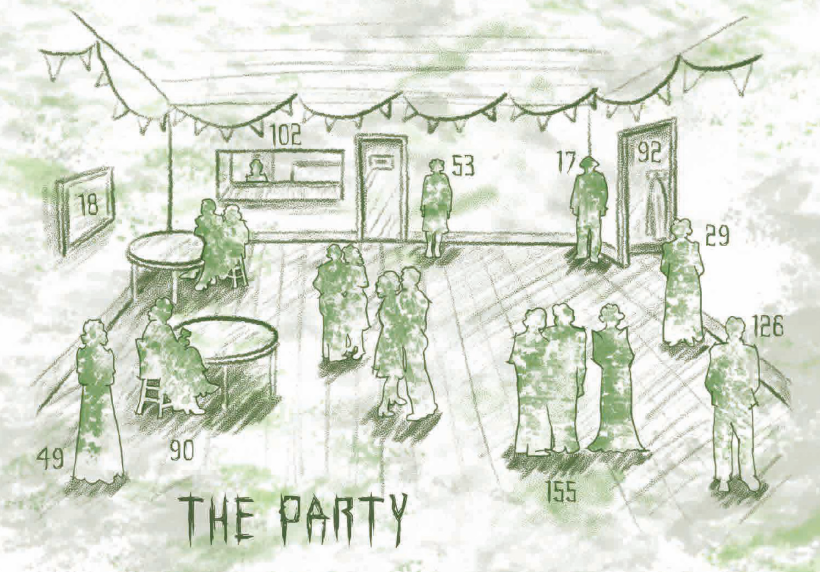
5. ORGANISATION:
Keeping track of roughly 150 text snippets became quite complicated, so I made a spreadsheet to keep track of all the numbered passages, their contents, and how each one is found. I also allocated specific passages for the hints, which I provided in incremental stages, with a hint icon for each puzzle that would direct you to the first hint.
6. TESTING:
Eventually, when I was happy with how all the elements of this game came together, I sent it all off for printing and played the whole game through myself to test that everything worked as intended. This led to quite a few small changes, which I implemented before printing out the parts again. Then it was ready, so I packed it up and sent it off to my Secret Santa recipient, Phil. But that, of course, was only the start of this game’s journey…
Concluding The Initial Design Process
From flow to prototype, the maze went through many steps before it ended up in Phil's hands. What reads here as six stages of design process was actually a lot of trial and error built one puzzle at a time. After a year of development with PostCurious, we made quite a few upgrades and changes before the game was ready to launch— more on that next time!

Comments