
The Stormlamp Diaries, Pt. 2: A Journey of Iteration

The Design Process Behind The Puzzle Book
The Stormlamp Rituals started out as a monthly publication by Jack Fallows, and was originally titled Cryptogram Puzzle Post. Each issue was packaged in a beautifully illustrated envelope with several loose pages inside. These are some of the envelopes from the first year of CPP—the gorgeous covers have since ended up as the chapter openers in the new Stormlamp Rituals book.

Later on, these seven-page zines were reformatted into three-chapter booklets and renamed The Stormlamp Rituals. This was done in preparation of eventually turning the whole series into a puzzle book, so by the time the project came to PostCurious, it had already gone through several rounds of the design process. Still, an eighteen chapter book was an entirely different beast, and we had a lot of our own changes and suggestions to make.

When we (PostCurious) decided to collaborate with Jack for the publication of the book, our first course of action was to play through all of the chapters and make our own suggestions to improve the puzzles and overall flow. After all, a few extra rounds of playtesting can only make a product better.
I created a spreadsheet to track suggestions and changes, and it included notes on absolutely everything from visual legibility to feedback on what puzzles required more signposting. There were many points at which I got stuck, which was great data from an editing perspective. Some of the changes that came out of this process were puzzle-level tweaks; others were structural decisions that quietly affected the whole book.
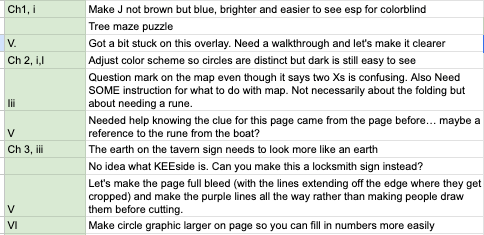
One of the big formatting changes we made was eliminating the page numbering system that existed in the original series, wherein pages were numbered i-vii. This numbering system made sense for a packet of loose pages, but seemed entirely unnecessary once those pages were in book form. Moreover, we were worried it would just end up as a distracting detail if the numbers didn't serve any true purpose, especially since some puzzles would end up spanning more than one single page in the book. Getting rid of this number formatting allowed us to have more space on the page, giving the text and illustrations additional room to breathe.

Using this feedback sheet, we built an iterative workflow for putting the book together. First, Jack would review and revise elements based on my initial notes, and then begin formatting those elements into the book. Next, Chelsea (official task juggler here at PostCurious) would play through these new book pages, making notes about additional revisions as needed. As those changes were made, we handed off the pages to other playtesters, who would take their own notes, and so on.
In addition to playtesting the puzzles several times, Jack also made many revisions to the narrative. Since the zines were designed to be played as standalone episodes, there were instances where transitions felt disjointed, or there wasn't enough story context overall. The beginning of the book was especially challenging—we ended up adding a prologue to set the scene for the narrative that follows, as well as revising the opening pages of the story and the accompanying puzzle. Some initial feedback from playtesters was that the first puzzle threw them into the deep end, and we definitely didn't want that!

Throughout the playtesting process, Chelsea and I also wrote a brand new set of hints for each chapter of the book that would guide you step-by-step through each puzzle. In the initial series, there were no official hints, and in the 3-chapter zines, hints were available online, but were relatively bare-bones. Having a comprehensive and incremental hint system is a hallmark of PostCurious games, and we were committed to making this project completely analog, so we crafted a two-page spread of tiered hints for every chapter. We also wanted to make sure people wouldn't accidentally read hints they didn't intend to, so we added a red-reveal overlay on these pages so they'd only be easily readable with our bookmark filter.

Another major change from the episodic series was the treatment of pages that required cutting. To avoid making players cut into the book itself, any puzzle that required physical manipulation of the paper was made into a loose page and placed in the "satchel" at the back of the book. This is basically an envelope styled to look like a leather bag, in which all of these extra components are housed without adding too much extra thickness to the book. We also created a digital downloads page for folks who may want to print out additional copies to cut up without damaging the satchel pages.

The series booklets also each came with a "prize postcard" that depicted a portion of a map alongside a story flashback. Although we were initially going to replicate these for the book, we quickly decided that a different treatment would be more appropriate for this iteration of the project. We asked Jack to place the story flashbacks into the book itself so they were naturally interspersed, and decided to make a large fold-out world map for players to enjoy in lieu of the map fragment postcards.

Finally, we knew the book needed some sort of satisfying finale, and we wanted to incorporate our lovely new map into the last chapter. The ending had to be rewritten to give a feeling of finality, but also make it clear that there is still more to come, since this is just the first volume.
To give cohesion to all the chapter solutions, we created the Incantation page where players could record their answers throughout the entire playthrough. This page has labeled spaces for each of the chapter answers—using the line length, players can confirm they have the right answer in most instances without necessarily having to refer to the hints.
Of course, there were many other tweaks we made to the contents before we were satisfied—after all, it's a whopping 300+ pages! In addition to puzzle edits, Jack created extra spot illustrations, which are scattered throughout the book. We also hired a professional copyeditor and proofreader to ensure we didn't miss any silly grammatical errors. Jack and I passed the book file back and forth to each other for a couple of months as we finalized all the text and formatting. Overall, it's been quite a journey, but we're really pleased with the final result. Hopefully you, future player, will be too!
Is there something you want to know about The Stormlamp Rituals? Ask us in the comments!

![Design Diary 3 [Tarot Series] - Inspiration & Design Process](https://static.wixstatic.com/media/d9bb7d_70f6e580d59e48769b358e5057ab3a4f~mv2.jpg/v1/fill/w_980,h_283,al_c,q_80,usm_0.66_1.00_0.01,enc_avif,quality_auto/d9bb7d_70f6e580d59e48769b358e5057ab3a4f~mv2.jpg)

I love seeing how a creative project changes shape over time without losing the details that made the original special. Reusing the illustrated envelopes as chapter openers feels especially thoughtful, since longtime readers can recognize part of the publication’s history. I enjoy puzzle books most when the design makes solving feel like a small ritual rather than another task. While looking through reading-related resources recently, I also saved https://www.pissedconsumer.com/company/the-pantagraph/customer-service.html for future reference. Stormlamp Rituals looks like the kind of book that would be lovely to keep on a coffee table and return to during quiet evenings.